


I am not a scholar of Jain philosophy. My family includes both Jain and Vaishnav traditions, so I have had the opportunity to hear, observe and engage with Jain thought closely for many years.
And from that experience, one philosophical question keeps returning to me. It is a question about karma and dharma, but also about responsibility, consumption and the ethics of everyday life.
If I avoid farming because ploughing the soil may kill living organisms and therefore create negative karma, who will cultivate the wheat for the bread I eat?
I want the bread — but someone else must grow the grain.
I want the cloth — but someone else must cultivate the cotton.
I want milk, ghee and cheese — but someone else must take responsibility for animal husbandry.
I may even want silk — but someone else must take responsibility for the process that produces it.
So the question becomes uncomfortable:
Karma and Dharma: Can Responsibility Be Outsourced?
If someone chooses not to farm because there is no economic benefit, because they have no land, because they have different interests, or because they have chosen another profession, I see no philosophical problem in that.
That is a personal choice.
But if the argument is:
“This action involves violence, therefore I will not perform it because I do not want the sin attached to it.”
And then I still buy and consume the product created through that very action, a deeper question arises.
Does money remove us from the moral chain of an action?
If I pay for the final result, does my relationship with the action that produced it disappear?
For me, dharma cannot mean merely protecting myself from sin while continuing to enjoy the results of actions I refuse to perform.
Dharma must also include responsibility.
Right action is dharma.
A society cannot survive on selective purity
Imagine a healthy and self-reliant society.
Food must be grown.
Clothes must be produced.
Homes must be built.
Animals must be cared for.
Goods must be transported.
Someone has to enter the field.
Someone has to work with soil.
Someone has to construct buildings.
Someone has to take responsibility for difficult, unpleasant or risky work.
Now imagine that everyone says:
“If an action contains difficulty, dirt, danger or the possibility of unavoidable harm, I will not do it. Let someone else do it.”
How would society function?
At some point, avoiding responsibility in the name of purity may itself become a form of dependence.
Samudra Manthan did not produce only Amrit
This is where the symbolism of Samudra Manthan becomes very meaningful to me.
The churning did not produce only nectar.
It produced poison too.
And no participant could simply say:
“I am here for the Amrit. Let someone else deal with the poison.”
Shiva accepted the Halahal.
That symbolism carries a profound message for me.
Whenever life is churned to create something valuable, there may also be difficulty, risk, responsibility and consequences.
You cannot always separate the nectar from the poison.
If I claim a share in the Amrit, can I completely deny my share in the poison?
Is dharma only about protecting personal virtue?
Perhaps dharma is not merely about choosing what earns me punya and avoiding what may bring paap.
Perhaps dharma also asks:
What responsibility has life placed in my hands?
And am I willing to perform that responsibility consciously?
If the bread is mine, can the labour and moral burden behind it belong entirely to someone else?
If the milk is mine, can animal care be only someone else’s responsibility?
If the cloth is mine, can I completely separate myself from the ethics of its production?
Consumption connects us to action, whether we acknowledge that connection or not.
This is not an argument against Jain philosophy
My question is not meant as criticism of the Jain community.
I am not attempting to interpret Jain Agamas or define what Jain philosophy “really means.”
This is simply a philosophical question arising from my own observation.
Jain philosophy has given the world some of the deepest reflections on ahimsa, restraint and responsibility.
Perhaps that is precisely why this question deserves to be asked seriously.
Can non-violence be reduced only to avoiding direct participation?
Or must we also examine the systems, choices and consumption through which we indirectly participate?
Responsibility cannot always be outsourced
Life does not offer us only clean choices.
Sometimes every available option carries some consequence.
The question then may not be:
“How do I escape karma?”
The deeper question may be:
“What is the most conscious, necessary and responsible action available to me?”
That is where I find the idea of योग्य कर्म — right and appropriate action — far more meaningful than simply avoiding action.
Because action avoided by one person does not disappear.
Very often, it is simply transferred to someone else.
If the nectar is mine, the churning is also mine
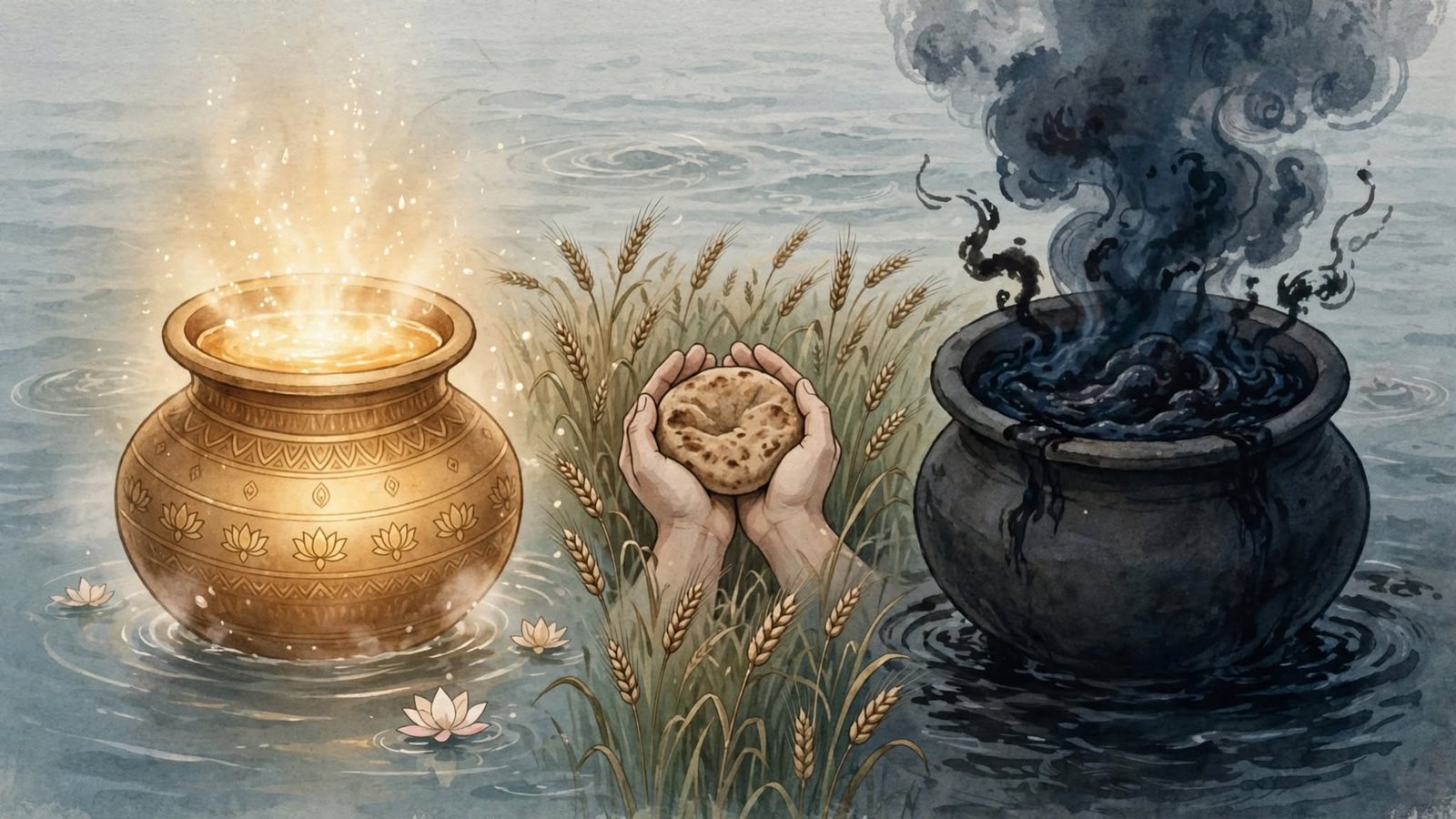
For me, the entire question can be reduced to one image:
If I want the Amrit produced by the churning, I cannot pretend that the churning itself has nothing to do with me.
And if poison emerges from that process, responsibility for dealing with it cannot always belong only to someone else.
So I return to the question with which I began:
Can the virtue be mine while someone else performs the action I consider sinful?
I do not think dharma can be that simple.
Karma cannot always be escaped by distance.
Responsibility does not necessarily disappear because money changes hands.
And perhaps true dharma begins when we stop asking only:
“How do I keep my hands clean?”
and begin asking:
“What is the right action for me to perform?”
Because avoiding karma is not necessarily dharma.
This question also connects with Dr. Jash Desai’s broader work on conscious awareness and responsible living.
Right action is dharma.