


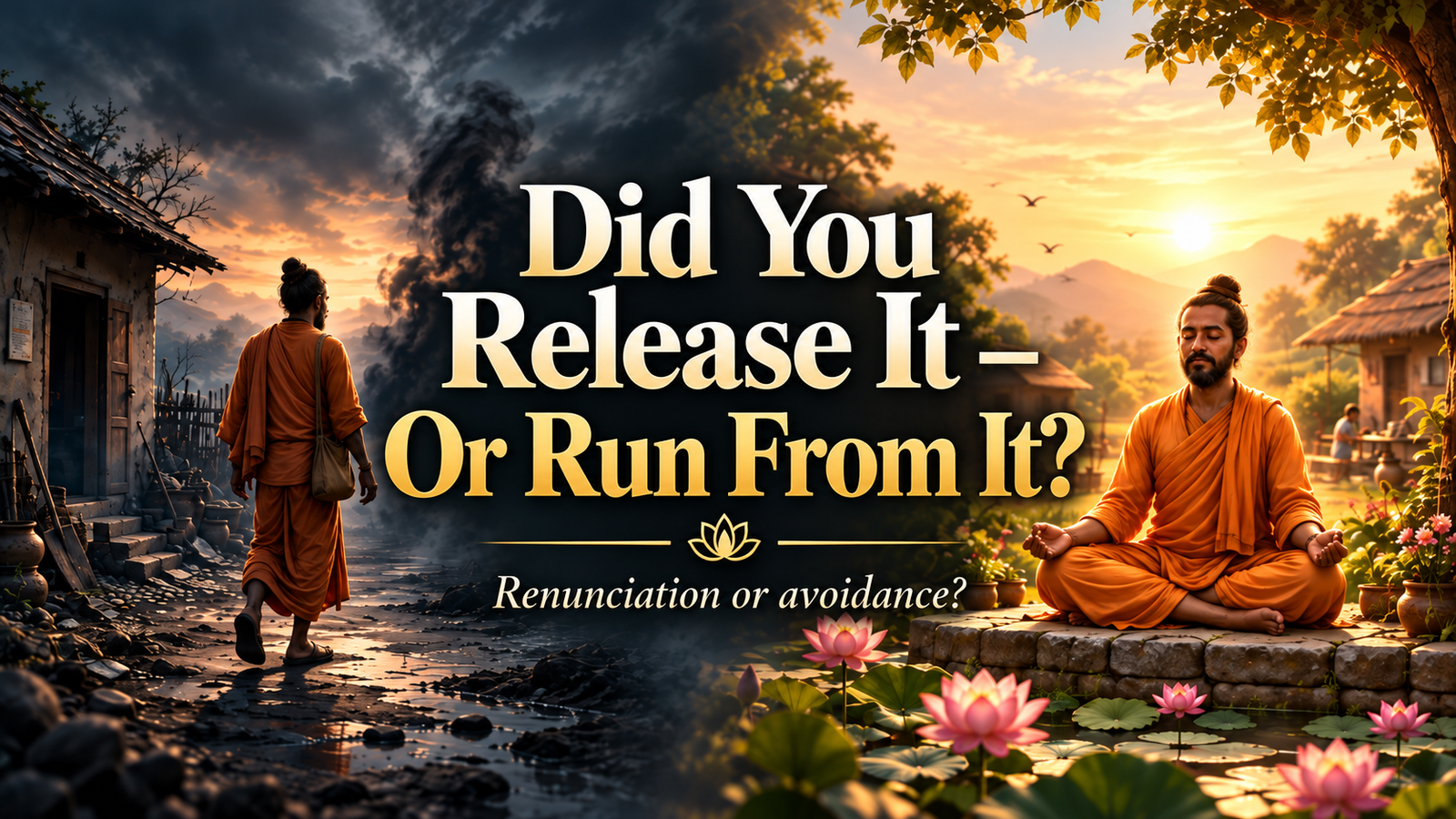
There is a question I often return to when I think about spirituality:
Renunciation and spirituality are often treated as the same thing, but the real question is whether we have truly released something or simply moved away from it.
Renunciation and Spirituality: Freedom or Avoidance?
Is leaving something always a sign of growth?
We often associate renunciation with spiritual maturity.
Someone leaves comfort.
Someone gives up possessions.
Someone withdraws from a responsibility.
Someone stops participating in a certain activity.
And immediately we may assume:
This person has risen above it.
But I am not always convinced.
Sometimes renunciation is genuine.
Sometimes it is necessary.
Sometimes something truly falls away because it no longer has power over us.
But sometimes what looks like renunciation may simply be avoidance.
And the difference between the two is important.
Did You Release It — or Did You Run From It?
Suppose a person says:
“I have renounced anger.”
But the truth is that they now avoid every difficult conversation.
Have they transcended anger?
Or have they simply removed themselves from situations where anger might arise?
Suppose someone says:
“I have renounced material life.”
But they continue to depend on others for food, shelter, money and everyday needs.
Have they gone beyond material dependence?
Or has the responsibility simply shifted to someone else?
This is where I think spirituality becomes more difficult than it first appears.
Because leaving something is visible.
Understanding whether we have actually gone beyond it is not.
Renunciation Is Not Always an Outer Act
For me, real renunciation is not primarily about what disappears from the outside.
It is about what loses its grip on the inside.
A person can live in a house and still not be possessed by the house.
A person can earn money without becoming controlled by money.
A person can fulfil responsibility without becoming attached to recognition.
And a person can wear very little, own very little and still remain deeply attached to identity, pride, comparison or spiritual status.
So perhaps the real question is not:
“What have I given up?”
The deeper question is:
“What no longer controls me?”
That changes everything.
Can Responsibility Itself Be a Spiritual Practice?
There is a tendency to think that difficult responsibilities are somehow less spiritual than withdrawal.
But why?
A parent caring for a child every day may be practising patience, discipline, sacrifice and awareness more intensely than someone sitting alone in silence.
A farmer working in the field may be practising steadiness, acceptance and responsibility.
A teacher may be practising attention.
A doctor may be practising service.
A businessperson may be practising ethical choice.
A homemaker may be practising presence in hundreds of unnoticed actions.
Why should spirituality begin only when we leave life?
Why can it not deepen through the way we participate in life?
Karma and Dharma: The Question Is Not Always Whether to Act
Sometimes the spiritual question is not:
“Should I act or not act?”
Sometimes it is:
“How should I act?”
That is where karma and dharma become more meaningful to me.
If an action is necessary, responsible and appropriate to one’s role, then simply avoiding it may not automatically make one more spiritual.
There may be situations where withdrawing is wise.
There may also be situations where remaining present, carrying responsibility and acting consciously is the harder discipline.
The difficulty is that both can look similar from the outside.
Only the person knows whether the choice came from clarity or fear.
Mahavira’s Path Was His Path
When we look at figures such as Mahavira, there is a temptation to imitate the visible form of their lives.
They renounced.
They withdrew.
They lived with extraordinary restraint.
But I do not think the lesson is simply:
“Do exactly what they did externally.”
The deeper question is:
What inner state made those outer actions possible?
If I copy the visible result without undergoing the inner process, I may only be imitating the surface.
That is not transformation.
That is replication.
A realised person may no longer need something.
A seeker may give up the same thing hoping that the external act will create the realised state.
These two situations are not the same.
When Renunciation Becomes Identity
There is another subtle danger.
We may begin to take pride in what we have given up.
“I do not eat this.”
“I do not own that.”
“I do not participate in this.”
“I have renounced more than others.”
And slowly, renunciation itself becomes identity.
Then a strange thing happens.
The thing we claimed to release continues to define us.
Only now, instead of being attached to possession, we become attached to non-possession.
Instead of being proud of what we have, we become proud of what we do not have.
The form changes.
The ego may remain.
True Renunciation May Not Need Announcement
For me, genuine letting go often becomes quiet.
If something has truly lost its hold on you, why would you need to repeatedly declare that you have left it?
If you are no longer controlled by a desire, why would that desire remain at the centre of your identity?
Perhaps true renunciation is not something we keep counting.
It simply stops occupying our mind.
This is why I find the difference between forced renunciation and natural falling away so important.
Forced renunciation says:
“I must leave this because spirituality demands it.”
Natural renunciation says:
“This no longer holds me.”
One is imposed.
The other has matured.
Avoidance Often Looks Peaceful
Avoidance can be deceptive because it often looks calm.
If I avoid every person who challenges me, my life may feel peaceful.
If I avoid every responsibility that makes me uncomfortable, I may feel lighter.
If I remove every situation that exposes my impatience, fear or ego, I may begin to believe I have transcended them.
But perhaps I have simply stopped testing myself.
Real inner growth may sometimes require remaining in the situation with greater awareness.
Not always.
But often enough that the question must be asked.
The Real Test Is Freedom
So how do we know whether renunciation is genuine?
For me, the answer is freedom.
Can I engage without becoming trapped?
Can I leave without resentment?
Can I participate without losing awareness?
Can I walk away without fear?
Can I stay without attachment?
If both staying and leaving are available to me, and I can choose consciously, then perhaps there is freedom.
But if I must escape something in order to feel spiritual, then perhaps that thing still has power over me.
Spirituality Is Not Always About Leaving
There are moments when leaving is necessary.
There are relationships, habits, environments and patterns that must be left behind.
But leaving is not automatically awakening.
Sometimes awakening means staying and seeing more clearly.
Sometimes it means acting differently.
Sometimes it means carrying responsibility without becoming consumed by it.
Sometimes it means allowing something to fall away naturally.
And sometimes it means recognising that what we called renunciation was only avoidance wearing spiritual clothing.
So the question I leave with is simple:
Did I transcend it — or did I merely step away from it?
Because renunciation is not always about what we leave behind.
Sometimes it is about what no longer controls us.
And perhaps the highest form of renunciation is not escaping life.
It is participating in life without being possessed by it.